
 LinkedIn
 Facebook
 X.com
X.com
 WeChat
 Email
Email
ESG strategy and governance
We take active responsibility for our ESG impacts in the society and environment in which we operate. While this has always been our core belief, our understanding of what active responsibility constitutes has changed over time. And never more than in the last few years.
Evolving our strategic approach
Our sustainability efforts are anchored in our business strategy, our purpose and values, and informed by our material sustainability impacts, risks and opportunities. In 2025, we initiated a review of our sustainability strategy to ensure that our commitments and efforts remain fit for purpose, considering key changes in the external context, our customers’ need for resilient supply chains and our ambition to do better in a constantly changing world.
Widely different expectations continue to evolve around the contributions and responsibilities of companies in addressing broader societal issues, from climate action and environmental sustainability to human rights, social impact and inclusive work practices. As a global company, we work with a diverse range of stakeholders from all parts of the world while operating in accordance with local regulations and our fundamental values and culture, accommodating and embracing differences in values, opinions and perspectives, and doing what is meaningful for our business and customers.
Against this backdrop, Maersk continues to pursue our sustainability ambitions with a clear focus on long-term business value, while supporting customers as they turn their priorities into practical, scalable solutions across diverse regulatory and reporting environments. Read more in our 2025 annual report.
Maersk’s Sustainability strategy
By integrating global logistics, we improve the flow of the foods, goods, and materials that sustain people, businesses and economies across the world.
In line with our integrator strategy and guided by our values, our three sustainability ambitions and the priorities behind them focus on issues that matter to our business, our customers, and society, and where we can make a meaningful impact:


No company can drive transformative change alone. Maersk depends on collaborative innovation and supply chain partnerships with customers, suppliers, peers and regulators that share our ambition to do better in a constantly changing world.
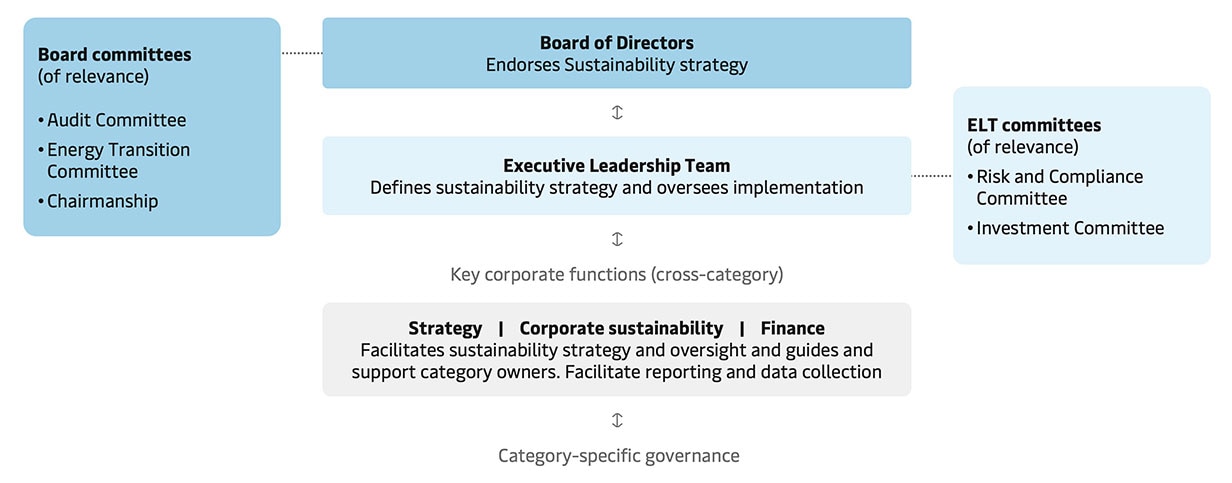
Our Sustainability governance framework
The Audit Committee oversees Maersk’s double materiality assessment, external ESG reporting, data quality and internal controls.
At the executive level, dedicated sponsors are allocated to Maersk’s material sustainability categories. This sponsorship includes driving initiatives forward and accountability to the full ELT and the Board of Directors for the development of and delivering on targets and policies. Responsibility for executing on the sustainability strategy resides with dedicated teams within relevant functional areas reporting to the respective ELT sponsors.
The Risk and Compliance Committee (RCC) is the main executive governance forum for sustainability and ESG. The RCC execute oversight of risks, controls and compliance in Maersk on behalf of the leadership team as well as act as a governance - and escalation point for issues related to sustainability and ESG reporting.
Sustainability in our central governance framework
In addition to the dedicated Sustainability and ESG governance model illustrated below, ESG topics are integrated into other internal governance processes, including Commit, Maersk's central governance framework. The Commit framework consists of 35 internal governance rules determining the goals and boundaries for our actions. Each rule has a designated owner in the organization who is responsible for compliance reporting to the Risk and Compliance Committee.
Executive oversight of compliance with Commit is anchored in this committee, where three members of the Executive Leadership Team meet quarterly. The expectations of all employees on ESG compliance are described in the A.P. Moller - Maersk Code of Conduct.
ESG risks to business
As part of the DMA, Maersk assesses sustainability-related risks that could lead to financial or reputational impacts, including those linked to environmental and social dependencies. For this assessment, we draw on Maersk’s enterprise risk management (ERM) framework, which assesses top risks to achieving our business plan within a 5-year horizon.
Our assessment also incorporates insights from internal experts and external stakeholders, including specialists in climate, nature, governance and human rights. Through ongoing engagement channels, we gather input on priority topics, which informs materiality assessments and guides the development of ESG initiatives.
The topics covered by the financial impact assessment for 2025 are climate change, pollution, ship recycling, retaining and attracting critical talent, working conditions, equal treatment, other work-related rights (forced labour, data privacy), ethical use of data and AI, supplier relationships, corruption and bribery and tax.
Annual Report 2025
Learn more about sustainability at Maersk


Learn more about Maersk

Careers

Follow us on LinkedIn
